How to Use a Butt Plug for the First Time? Beginner's Guide

On this page
For your first time, choose a butt plug designed for anal use, with a flared base and clearly listed specifications. Make sure the surface is intact and have a compatible lubricant ready. Keep the base outside your body during use, and stop if you feel pain or noticeable resistance. Clean the plug afterward according to the instructions for your model.
A common problem for beginners is that a product is labeled “Small” without telling you exactly which part is small. Take a minute to read the specifications before deciding whether the plug is right for you.
Start with the anatomy: Where are the anus, anal canal, and rectum?
The anus is the external opening, and the anal canal is the short passage leading inward to the rectum above it. The internal and external sphincters around the anal canal help control bowel movements. The body mainly controls the internal sphincter automatically, while you can contract the external sphincter voluntarily. Sensation also varies across different parts of the anal canal, so “it doesn't hurt right now” alone cannot tell you whether the size or wear time is right for you. Cleveland Clinic's guide to anal anatomy
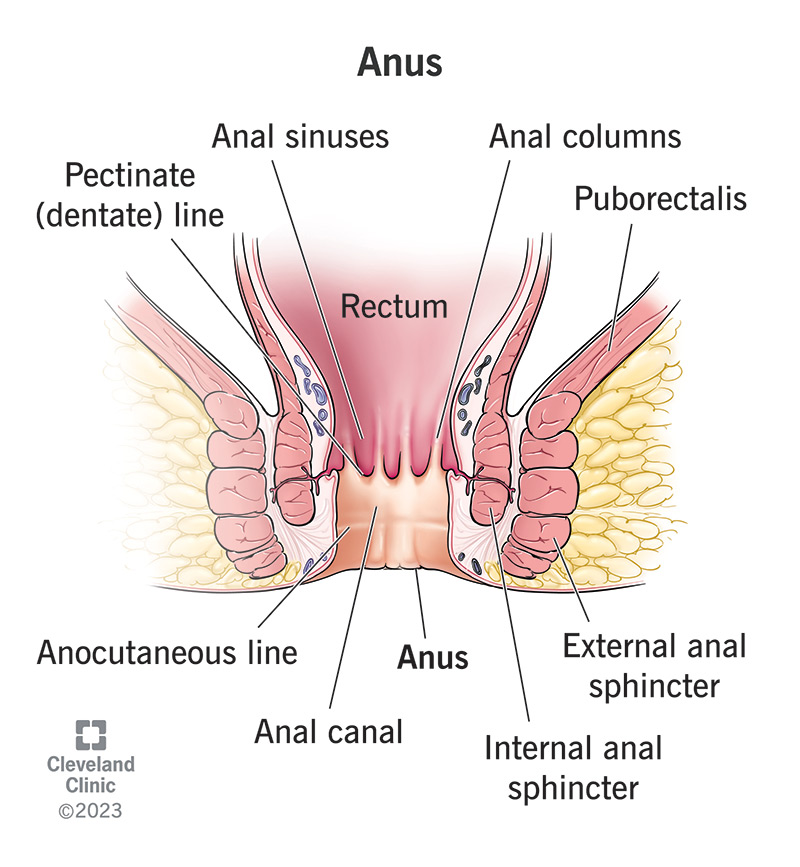
On a product listing, “insertable length” is a measurement of the product. To compare two models, also look at the widest part of the body, the neck, and the base. Pause if you feel noticeable resistance, and don't feel that your body has to adapt to a particular labeled size. Cleveland Clinic's guide to anal sex safety
What should you choose for your first time? Check the base, then the widest part of the body

Illustration: The general structure of a butt plug.
- Base. The base stays outside the body and helps prevent the entire plug from slipping inside. Choose a product specifically designed for anal use with a flared base. When it arrives, check that the base is intact and that the joint is free of cracks or looseness. Planned Parenthood's guide to sex toys
- Body. Check the widest part. Two models can both be labeled Small, yet one can be shorter and wider. Compare the same part of each model using the same units. If the listing only gives the overall length, ask customer service how wide the body is at its widest point.
- Neck. The neck is the narrower section between the body and the base. Even when the bodies are equally wide, one neck may be thicker than the other, and the transition from the body to the neck can differ too. A dimension drawing makes those differences easier to see than the label “beginner-friendly.”
After comparing those three parts, look at the material, weight, controls, and cleaning requirements. A non-powered model has no charging or connection settings to deal with. If you're considering a vibrating model, check how to turn it off before use and whether you can still operate it from the device itself when it is disconnected from your phone. Daziner's guide to butt plug anatomy and types
How do you choose a plug? Check what touches your body, how firm it is, and how to clean it
- Silicone. Products labeled “silicone” can still differ in firmness. A powered model labeled “silicone exterior” may also contain a rigid shell or motor. To get a sense of how it will feel, check the material that touches your body and the firmness of the finished product. Stop using it if the surface is cracked or the layers are separating.
- Glass and stainless steel. These materials are rigid, so it is worth comparing each product's weight, profile, and base shape separately. Make sure the finished product is designed for anal use and that the surface is intact. Stop using it if the glass is cracked or chipped, or if the metal has burrs.
- Unclear material labeling. If the listing only says “soft” or “skin-friendly,” ask the seller what the body, neck, and base are each made of and how they can be cleaned. If it claims to be “medical-grade” or to meet a particular standard, also ask whether the test documentation covers the raw material or the finished product.
Follow the cleaning instructions for your specific model, especially if it is powered. Knowing the outer material alone cannot tell you whether the product can be soaked or heated. Brown University BWell's guide to sex toy materials · Official summary of ISO 3533:2021 · Daziner's sex toy care guide
How do you choose a lubricant? Check compatibility with both the toy and the condom
Water-based lubricant is usually a starting point with broad compatibility. If you're unsure what to use at first, choose a water-based product that the instructions allow. If it starts to feel dry or drag, pause and reapply as needed. Silicone-based lubricant usually lasts longer, but it can affect the surface of some silicone toys. Choose water-based lubricant unless the manufacturer explicitly confirms compatibility with your model. Oil-based lubricants, including coconut oil, cannot be used with latex condoms. Check the packaging if you use a condom made of another material. Daziner's guide to lubricants for silicone toys
If you use a silicone butt plug with a latex condom, a water-based lubricant allowed by both sets of instructions is usually the easiest choice to verify. Lubricant reduces friction. If you still feel noticeable resistance, tightness, or pain after reapplying, end the attempt. Numbing products can make it harder to notice pain. Cleveland Clinic's guide to anal sex safety · Daziner's guide to numbing lubricants
Three things to check before use
- Check the product. Clean it according to the instructions and make sure the surface and base are intact. For a powered model, get familiar with the controls and cleaning limits, and check whether water can come into contact with the area around the charging port.
- Keep a lubricant you have confirmed is compatible within reach. Also make sure you can grip the base and stop at any time.
- Wash your hands and clean the outside of the anus. If you feel the need to have a bowel movement, use the bathroom first. Douching is usually unnecessary. If you have anal pain or bleeding that has not been addressed, pause and consult a healthcare professional. Columbia University's health Q&A · Healthdirect's guide to anal injuries
Safe stretching and relaxation: What should you do if you feel tightness?
Start by finding a position that lets you stay steady, breathing slowly, and giving yourself time to relax. If what you mainly notice is surface dryness or dragging, pause and check whether you have enough lubricant. Stop if you still feel tightness or noticeable resistance when advancing after reapplying lubricant, or if you feel pain. If you want to try again another time, compare the size and profile again first. Beginners can start with a model they feel comfortable handling, without setting goals for practice or moving up in size. Cleveland Clinic's guide to anal sex safety
What is the Butt Clock technique?
How to do it. Picture the anal opening as a clock face, with 12 and 6 at the top and bottom and 3 and 9 at the sides. Put lubricant on your fingertip, gently move it just inside the opening, then apply gentle pressure in each direction on the clock face. Using the order in the original Reddit post, gently press toward 12 o'clock for about 30 seconds, release, and move to 3, 6, and 9 o'clock, spending about 30 seconds at each position. Apply gentle pressure only in the direction you are working, and avoid pushing your fingertip farther in. You can repeat the sequence until you feel relaxed. Original Dr. Carlton interview ·
What healthcare organizations recommend. Stop if you feel noticeable resistance and avoid applying more force. Healthdirect advises stopping anal sexual activity and seeking medical care if you experience anal pain or bleeding. For recurring pelvic floor tightness or pain, Cleveland Clinic recommends an assessment by a healthcare professional, with a pelvic floor physical therapist guiding relaxation and coordination exercises when needed. Healthdirect's guide to anal injuries · Cleveland Clinic's guide to hypertonic pelvic floor
How do you use a dilator?
- Choose a size and apply lubricant. Following the original post, start with the smallest size and apply a compatible lubricant to the part of the dilator that will touch your body and to the outside of the anus.
- Insert it slowly and pause for a few seconds. Go only as far as the point where you first feel a slight stretch. We describe this mild discomfort as 1–2 out of 10. Stop if you feel noticeable resistance, and discontinue use and seek medical care if you have pain or bleeding.
- Slowly draw it back to just inside the opening, then return to the same point. Each time, go only as far as the same point and don't push farther in. The original post describes about 3–5 minutes in total, a few times a week, without specifying a number of repetitions per session.
- Consider moving up a size once the current size goes in easily and you feel no discomfort throughout.
How much bigger should the next size be?
Increase the maximum body diameter by no more than 0.3 inches (about 7.6 millimeters) at a time, and use “about 1 inch in circumference” to give readers a sense of the difference. When comparing two models, compare maximum diameter with maximum diameter, and also check the neck, profile, and firmness. If your current size feels right, you can keep using it. If you feel noticeable resistance or pain after switching models, stop and reassess. Cleveland Clinic's guide to anal sex safety
Should you do Kegels or reverse Kegels? Kegels mainly train you to contract the pelvic floor muscles. If your pelvic floor muscles are already tight, repeatedly contracting them can make the problem harder to manage. Online, relaxation exercises are often called “reverse Kegels,” and the specific exercises depend on your symptoms and assessment. If you have recurring pain, difficulty with bowel movements, or persistent tightness, ask a doctor or pelvic floor physical therapist whether to work on relaxation, coordination, or another approach. Cleveland Clinic's guide to Kegels · Cleveland Clinic's guide to hypertonic pelvic floor
How do you use it for the first time? Go at a pace that lets you stop at any point
Choose a stable position you can control, such as lying on your side. Apply an appropriate amount of compatible lubricant to the outside of the anus and the parts of the product that touch your body, then proceed gently and slowly. Keep the base outside your body and within reach so you can grip it. Stop if you feel noticeable resistance, stinging, burning, or worsening pain. If you can remove it easily, do so slowly. You can end the attempt and decide whether to try again once the discomfort has been addressed. Cleveland Clinic's guide to anal sex safety · Healthdirect's guide to anal injuries
Should a butt plug hurt? The first time, you may feel pressure or an unfamiliar sensation. Pain or bleeding is a sign to stop. Lubricant can reduce friction. If it still hurts, avoid applying more force, trying repeatedly, or using numbing products to mask the pain. Consult a healthcare professional if symptoms persist or recur. Daziner's guide to numbing lubricants · Healthdirect's guide to anal injuries
What if it gets stuck? If the product slips inside and gets stuck or you can't remove it, go straight to the emergency department. Avoid trying to pull it out with tools. If you have heavy bleeding, severe pain, or feel like you might faint, seek emergency help immediately. You can tell the medical team the toy's size and shape, whether it is powered, and roughly when it got stuck. Healthdirect's guide to anal injuries · Daziner's guide to getting medical help for a stuck toy
Safety tips
If you feel stinging, numbness, or pain while wearing a butt plug, stop. If you can remove it easily, take it out slowly. If it is stuck or you can't remove it, go straight to the emergency department. Sensitivity to pain varies across different parts of the anal canal, so pay attention to stinging and numbness as well. Cleveland Clinic's guide to anal anatomy · Healthdirect's guide to anal injuries
Wear time
If it's your first time or you've just gone up a size, I suggest trying it for a short time first to see how comfortable it feels and how easily it comes out. With a narrow neck and a wide body, the sphincter sits around the narrow neck while you wear it, and the wider body still has to pass through the opening when you take it out. The bigger the difference between the two, the harder removal can be.
Some people wear a plug almost around the clock. If you've just moved up to a larger size, first pay attention to how this model feels while you wear it and when you take it out. Especially if you're trying to get used to a larger size gradually, don't suddenly extend your wear time just because insertion went smoothly this time. If you feel dryness or friction, pause and reapply a compatible lubricant as needed.
Overnight wear
If you're considering wearing a plug overnight, I suggest seeing how your body responds during the day first. If you've comfortably worn one for 6–8 hours during the day, pay attention to whether you felt pressure, stinging, or numbness during that time, and whether it came out easily at the end. These changes are harder to notice promptly once you're asleep. If it's your first time or you've just changed sizes, I suggest choosing a time when you're awake and can take it out at any point.
Friction, anal fissures, and internal hemorrhoids
A size that is too large, a steep transition from the neck to the body, or too little lubricant can all increase friction during insertion and removal. An anal fissure is a tear in the lining of the anal canal, and common signs are pain and bleeding, especially during bowel movements. Internal hemorrhoids involve vascular tissue inside the anal canal, and they often don't hurt when they haven't prolapsed, though they can still bleed. After prolapsing, they may cause pain or discomfort. American Society of Colon and Rectal Surgeons' guide to anal fissures · NIDDK's guide to hemorrhoid symptoms and causes · Kenhub's anal canal anatomy diagram
If it's only mild chafing, stop using the plug and see whether it improves over the next day or two. If you have pain or bleeding, stop using it and seek medical care. If you've had pain for a week already or it is getting worse, get checked as soon as possible. If you have heavy bleeding, severe pain, or feel like you might faint, seek emergency help immediately. Healthdirect's guide to anal injuries
After use, follow the cleaning instructions for your model
If you can remove it easily, turn off vibration or any other functions, grip the base, and gently remove it. Then clean the product according to its instructions. If the instructions allow washing with water, use warm water and mild, unscented soap, rinse off any residue, and dry it thoroughly. For powered models, check whether the device can be rinsed or only wiped down. If the toy will be used by another person or on another area of the body, clean it first and replace any barrier that was used. For details, see Daziner's guide to cleaning, drying, and storing sex toys · SH:24's guide to cleaning sex toys · SH:24's guidance on barrier use.
Common questions from beginners
Do I need to douche before the first time?
Usually, no. Routine washing on the outside is enough. If there is a little stool residue, you can pause and clean your hands, the external skin, and the toy. For the difference between external washing and rectal douching, see Columbia University's health Q&A.
Will a small size definitely fit me?
Brands use size labels differently. First check the widest part, the neck, the base, and the material. If the only similar measurement between two products is their length, you still need to ask about width. For your first time, consider a relatively small model with a base you can grip and specifications you can easily verify.
How long should I wear it the first time?
First check the intended use and the instructions for your specific model. Choose a time when you can stop at any point and pay attention to how your body feels. Battery life describes how long the battery can run. If you have pain or bleeding, follow the guidance above on when to stop and seek help.